Wittgenstein at the Movies by Béla Szabados
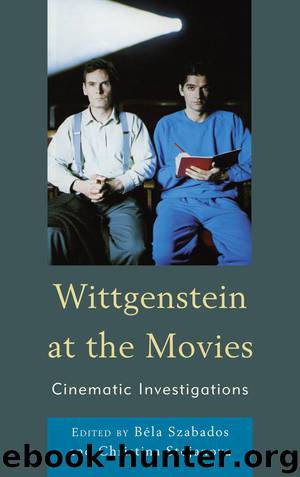
Author:Béla Szabados
Language: eng
Format: epub
Publisher: Lexington Books
NOTES
1. Stanley Cavell, “The Interminable Shakespearean Text,” in S. Cavell, Philosophy the Day after Tomorrow (Cambridge, MA: Belknap Press of Harvard University Press, 2005), 28–60; 34f.
2. Theodor W. Adorno, “Die Aktualität der Philosophie,” in Adorno, Gesammelte Schriften, Band I, ed. Rolf Tiedemann (Frankfurt/M: Suhrkamp, 1997), 325–44; 335. English version: “The Actuality of Philosophy,” Telos 31 (Spring 1977): 120–33; 126–27.
3. All quotations in this section (unless otherwise indicated) from Wittgenstein’s preface to: Ludwig Wittgenstein, Philosophical Investigations, eds. G. E. M. Anscombe, R. Rhees, trans. G. E. M. Anscombe, 3rd edition (Oxford: Blackwell, 2001), ix–x.
4. Derek Jarman, “This Is Not a Film of Ludwig Wittgenstein,” in British Film Institute, Wittgenstein: The Terry Eagleton Script\The Derek Jarman Film (London: BFI Publishing, 1993), 63–67; 66.
5. Theodor W. Adorno, Metaphysics: Concept and Problems, ed. Rolf Tiedemann, trans. Edmund Jephcott (Cambridge: Polity, 2000); see in particular lectures 4–6, 15–41.
6. See Adorno, Metaphysics, 41: “However, if one takes seriously the idea of mediation, which is sketched but not fully worked out in Aristotle, the idea that form and matter are really moments which can only be conceived in relation to each other, the question as to which of them comes absolutely first or is ranked absolutely higher becomes transparent as a false abstraction. And one will then trace the forms of the concrete mediation of these moments, instead of treating the product of abstraction which keeps them apart as the only rightful source of truth.”
7. Terry Penner, “The Forms and the Sciences in Socrates and Plato,” in A Companion to Plato, ed. Hugh H. Benson (Chichester: Wiley-Blackwell, 2009), 165–83; 179. I leave aside the thorny question exactly which Plato should be attributed with the views presented here. For an overview on Plato’s Forms, see William A. Welton, ed., Plato’s Forms: Varieties of Interpretation (Lanham, MD: Lexington, 2002).
8. “Incidentally, to take ‘each is one’ as sufficient to bring out what it is to be a Form is surely to suggest that what is in question is the existence of something additional to the spatial and perceptible particulars, such as a genuine attribute. It certainly does not suggest that for there to be a Form is for there to be some mystical, quasi-theological entity.” Penner, “Forms and the Sciences,” 181.
9. Penner, “Forms and the Sciences,” 177.
10. Wittgenstein, Philosophical Investigations, 195.
11. Terry Penner, “The Forms in the Republic,” in The Blackwell Guide to Plato’s Republic, ed. Gerasimos Santas (Oxford: Blackwell Publishing, 2006), 234–62; 247.
12. Penner, “The Forms in the Republic,” 248.
13. Penner, “The Forms in the Republic.” This immanent reading is further supported by the fact that at Republic 505a2–b3 “the Idea or Form of the Good is plainly identified with the Good” (249).
14. G. P. Baker, P. M. S. Hacker, Wittgenstein: Understanding and Meaning (Vol. 1 of An Analytical Commentary on the Philosophical Investigations, Part I: Essays), 2nd edition (Oxford: Blackwell Publishing, 2005), 222.
15. Baker and Hacker, Wittgenstein, 216.
16. Baker and Hacker, Wittgenstein, 275.
17. Baker and Hacker, Wittgenstein, 310 (emphasis added).
18. Baker and Hacker, Wittgenstein, 303.
19. Baker and Hacker write: “So, a perspicuous statement of a grammatical rule does not count as a thesis.
Download
This site does not store any files on its server. We only index and link to content provided by other sites. Please contact the content providers to delete copyright contents if any and email us, we'll remove relevant links or contents immediately.
The Great Music City by Andrea Baker(33722)
Aircraft Design of WWII: A Sketchbook by Lockheed Aircraft Corporation(32385)
Call Me by Your Name by André Aciman(20738)
The Secret History by Donna Tartt(19476)
The Art of Boudoir Photography: How to Create Stunning Photographs of Women by Christa Meola(18771)
Shoot Sexy by Ryan Armbrust(17855)
Plagued by Fire by Paul Hendrickson(17542)
Portrait Mastery in Black & White: Learn the Signature Style of a Legendary Photographer by Tim Kelly(17108)
Adobe Camera Raw For Digital Photographers Only by Rob Sheppard(17097)
Photographically Speaking: A Deeper Look at Creating Stronger Images (Eva Spring's Library) by David duChemin(16801)
Ready Player One by Cline Ernest(15152)
Pimp by Iceberg Slim(14805)
Bombshells: Glamour Girls of a Lifetime by Sullivan Steve(14223)
The Goal (Off-Campus #4) by Elle Kennedy(13968)
Art Nude Photography Explained: How to Photograph and Understand Great Art Nude Images by Simon Walden(13151)
Kathy Andrews Collection by Kathy Andrews(12099)
The Priory of the Orange Tree by Samantha Shannon(9367)
The remains of the day by Kazuo Ishiguro(9227)
Thirteen Reasons Why by Jay Asher(9129)
